_1779606969667-ZJZA6fNi.png)
_1777949319555-DTVd6WJp.png)
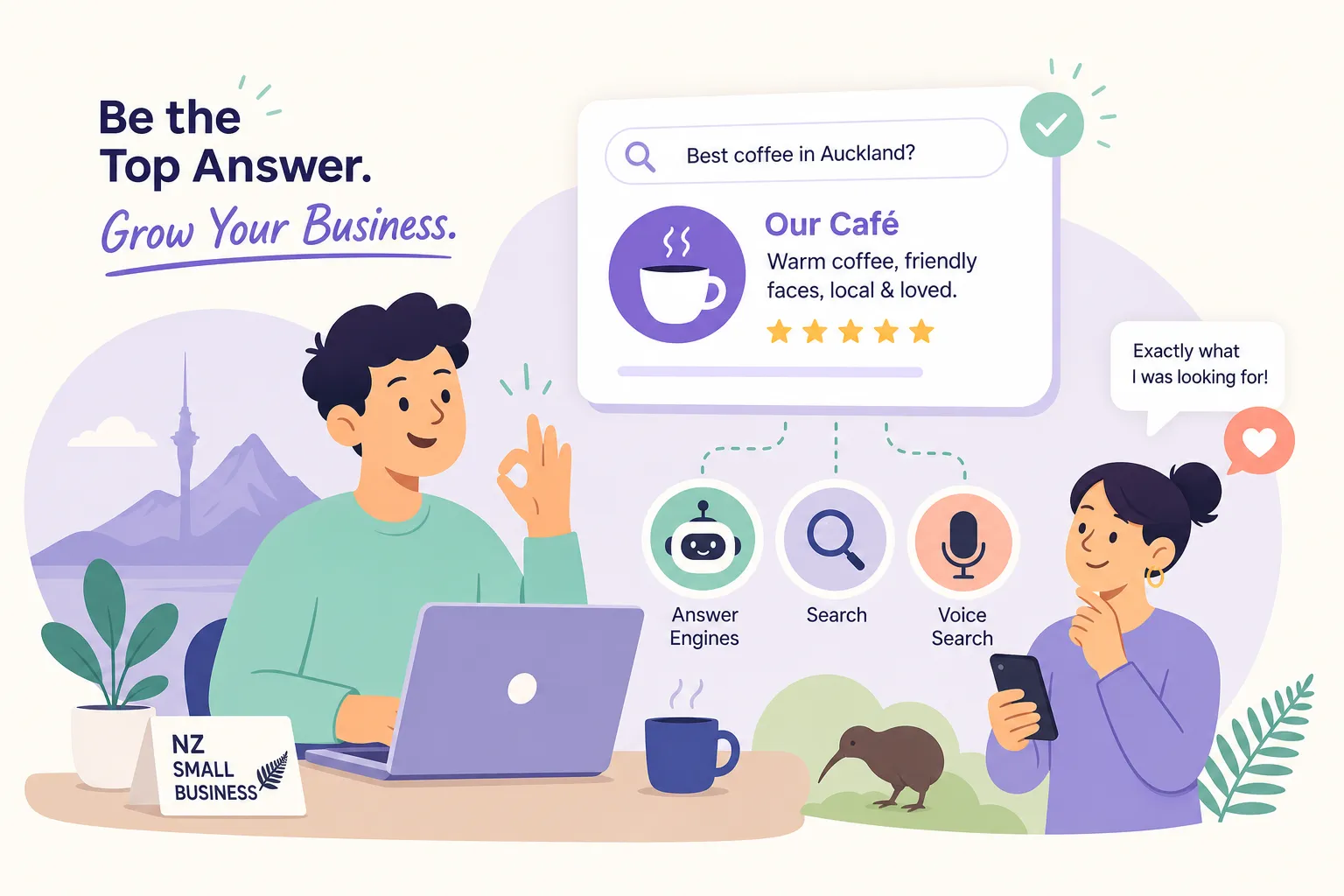
Answer engine optimisation NZ is changing how Kiwis find and choose local services, and most small businesses haven't caught up yet. Plenty of NZ businesses are still focused entirely on climbing Google's traditional results page, which is understandable — SEO has been the game for over two decades, and it still matters. But the way people actually search for services is shifting quietly underneath that assumption. AI tools like ChatGPT, Perplexity, and Google's AI Overviews now pull direct answers from websites and present them in chat responses, voice summaries, and generated overviews — often without a single click ever happening. According to Adobe's 2025 research, 62% of New Zealand consumers have used AI assistants more than once, in line with the global average, and usage shows no sign of declining.
The question isn't whether this affects your business — it already does. The real question is whether your website is structured so AI systems can find and use your content, or whether they'll quote a competitor instead. This is what answer engine optimisation (AEO) is about, and it's why agencies like Fairweb are already building it into our NZ website packages as a standard feature rather than an optional add-on.
What answer engine optimisation actually is
For decades, SEO was about climbing the results page and earning clicks. AEO is a different objective. Traditional SEO optimised content around keywords; AEO optimises for questions and clear, extractable answers. When someone asks ChatGPT "who's a good accountant in Christchurch?" or asks Google's AI Overview "what does a mortgage adviser actually do?", those tools pull content from websites and present it directly. The website that gets cited doesn't always get the click, but it gets the trust signal, the brand mention, and increasingly the enquiry from someone who's already further along in making a decision.
Natural-language questions, direct answer blocks, and structured formatting such as bullet points and numbered lists are the signals AI systems respond to. AEO builds on SEO rather than replacing it. Strong SEO foundations still matter, but AEO adds a layer of structure and clarity that makes your content genuinely useful to AI systems rather than simply discoverable by them.
Why NZ small businesses can't afford to ignore AI search
ChatGPT, Perplexity, and Google's AI Overviews aren't a future trend for New Zealand — they're already part of how Kiwis research and make decisions. Adobe's 2025 research found that NZ consumers are using AI assistants to search the web (33%) and to research or summarise information (53%). When a potential customer uses an AI tool to find a local service provider and your business doesn't appear in the response, you're likely to lose that lead before they've even seen a results page. For NZ trades, health practitioners, and service-based businesses that rely on local visibility, this is a meaningful and immediate change.
There's also the zero-click reality to contend with. Ahrefs reported a 34.5% decrease in clicks to websites ranking below an AI Overview, and a separate benchmark found a 58% lower average click-through rate for the top-ranking page when an AI Overview is present. Traditional traffic metrics are becoming less reliable as a measure of actual visibility. A business structured for AEO gets cited by name, associated with a direct answer, and placed in front of a customer who already trusts the source. For small businesses competing locally, that kind of visibility can decide whether you're part of the conversation or invisible to it.
What makes content quotable by AI systems
AI answer engines are built to extract clear, self-contained answers. They respond well to pages that lead with a direct answer in one or two sentences, use question-based headings phrased as real questions, and break information into short, focused paragraphs. Bullet points and numbered steps are commonly lifted directly into AI summaries. Pages that bury answers in long, winding paragraphs rarely get quoted. Conciseness and clarity aren't just good writing practice here — they function as a technical signal about the quality and usability of your content.
Structured data provides important supporting signals. FAQ schema is the most directly useful for AEO because it maps question-and-answer pairs in a way AI systems can interpret clearly. QAPage schema works well for pages structured as genuine Q&A content, and Article schema with JSON-LD helps AI systems understand page context, authorship, and topic relevance. These aren't magic switches, but they reinforce your on-page content and help AI systems trust and use your information more readily. It's also worth implementing LocalBusiness or Organisation schema with your NAP (name, address, phone number) details and keeping your Google Business Profile accurate and consistent — these local signals carry real weight in answer engine optimisation NZ searches. The visible content on your page remains the primary signal; schema supports it rather than replacing it.
Authority matters too. AI systems favour content that's corroborated across multiple sources, includes concrete information, and comes from sites that demonstrate clear expertise. Research into AI citation patterns has found instances where pages with minimal backlink profiles still earned significant AI citations because their data was original and specific. That's an encouraging signal for small businesses: you don't need massive domain authority to get cited, but you do need content that's genuinely useful, clearly structured, and easy to extract.
Answer engine optimisation NZ: a practical checklist
The content changes that move the needle most are straightforward to implement. Start by identifying the five to ten questions your customers actually ask, then build a dedicated page or clear section around each one. Open every answer with a direct, two-sentence response before expanding with supporting detail — this gives AI systems a clean passage to extract even if they ignore everything that follows. Rewrite your key H2 and H3 headings as natural questions, such as "How much does a website cost in New Zealand?" or "What's included in a local SEO package?" Keep answer paragraphs short — around 60 to 100 words for explanations, shorter for direct responses. Add a visible FAQ section to your main service pages with genuine questions and concise answers, written exactly as your customers phrase them.
On the technical side, the priority list looks like this:
- Implement FAQ schema using JSON-LD on pages with question-and-answer content.
- Add LocalBusiness or Organisation schema with accurate NAP details, and keep your Google Business Profile consistent with your on-site information.
- Ensure a clean heading hierarchy (H1, H2, H3) throughout each page with no skipped levels.
- Use semantic HTML elements such as article and section tags to make page structure clear to AI crawlers.
- Verify the site is fully indexed and crawlable, with clean metadata and descriptive page titles.
- Check that mobile performance and page load speed meet current standards, since AI grounding systems reference quality signals alongside content.
Should you handle AEO in-house or work with a local NZ agency?
AEO isn't technically impossible to handle without outside help. If you've got someone on your team who can write clearly, understands basic HTML, and is willing to learn JSON-LD schema, you can make real progress. The honest constraint for most NZ small business owners is time and consistency. The businesses that see the clearest gains from generative search optimisation are those treating it as an ongoing content discipline, not a one-off project — a reasonable commitment if you have the capacity for it.
Many small businesses find that working with a specialist speeds up implementation and reduces the guesswork considerably. Fairweb builds AEO and AI search readiness into NZ website packages from the ground up — covering content structuring, FAQ schema, heading hierarchy, page formatting, and visibility across AI tools including ChatGPT, Google's AI Overviews, and Perplexity. Everything's explained in plain language, making it a practical option for trade, service, or professional businesses that need to show up where customers are actually searching, without having to become technical experts themselves.
Customers are still looking for the services NZ small businesses provide every day. They're just asking the question in a different place — and increasingly, they're getting an answer before they ever click a link. AEO is something NZ businesses can act on right now: the checklist above is a solid starting point, but the businesses that adapt early will hold a clear advantage over those still waiting to see how this plays out.
The earlier you restructure your content for AI citation while keeping your SEO foundations solid, the more ground you hold before competitors catch up. Whether you work through the checklist yourself or partner with a team like Fairweb that already has the process built in, waiting means closing a gap from behind rather than building a lead from the front.
Frequently Asked Questions
What is Answer Engine Optimisation (AEO)?
Answer Engine Optimisation (AEO) is the practice of structuring website content so AI tools can extract and present clear, direct answers. Unlike traditional SEO, which targets keywords and clicks, AEO focuses on questions and concise, extractable answers that AI assistants can quote or summarise.
How is AEO different from traditional SEO?
AEO builds on SEO rather than replacing it: SEO still matters for discoverability, while AEO adds structure and clarity so AI systems can lift answers directly. That means leading with one- or two-sentence answers, using question-based headings, and breaking information into short paragraphs and lists.
Why should NZ small businesses care about AEO now?
AI assistants like ChatGPT, Perplexity, and Google's AI Overviews are already changing how Kiwis research services, and Adobe's 2025 research shows significant AI usage among NZ consumers. If your site isn't structured for AEO, competitors may be quoted by AI tools and capture trust and enquiries before users ever visit your pages.
What types of content are AI systems most likely to quote?
AI answer engines favour clear, self-contained responses: pages that start with a direct answer in one or two sentences, use real question headings, and break information into short paragraphs, bullet points or numbered steps. Those formats make it easy for AI tools to extract and present the information in chat or overview results.
How can a small business optimise its website for AEO?
Start pages with a concise direct answer, use question-based headings that mirror real search queries, and format details as short paragraphs, bullet points or numbered steps so answers are extractable. Maintain strong SEO foundations while adding this extra structure and clarity to make your content useful to AI systems.
Do AI Overviews and similar features reduce website clicks?
Yes — there's a zero-click reality to it. Ahrefs reported a 34.5% decrease in clicks to sites ranking below an AI Overview, and a separate benchmark found a 58% lower average click-through rate for the top-ranking page when an AI Overview is present. These trends mean traditional traffic metrics may understate real visibility without AEO.
Are any NZ agencies already offering AEO services?
Yes — agencies like Fairweb are building AEO into their NZ website packages as a standard feature rather than an optional add-on. That reflects a shift toward packaging AI search optimisation alongside traditional web services.
Related Service
AEO & AI Search Readiness
See how Fairweb supports New Zealand small businesses with aeo & ai search readiness.
Learn more