_1779606969667-ZJZA6fNi.png)
_1777949319555-DTVd6WJp.png)
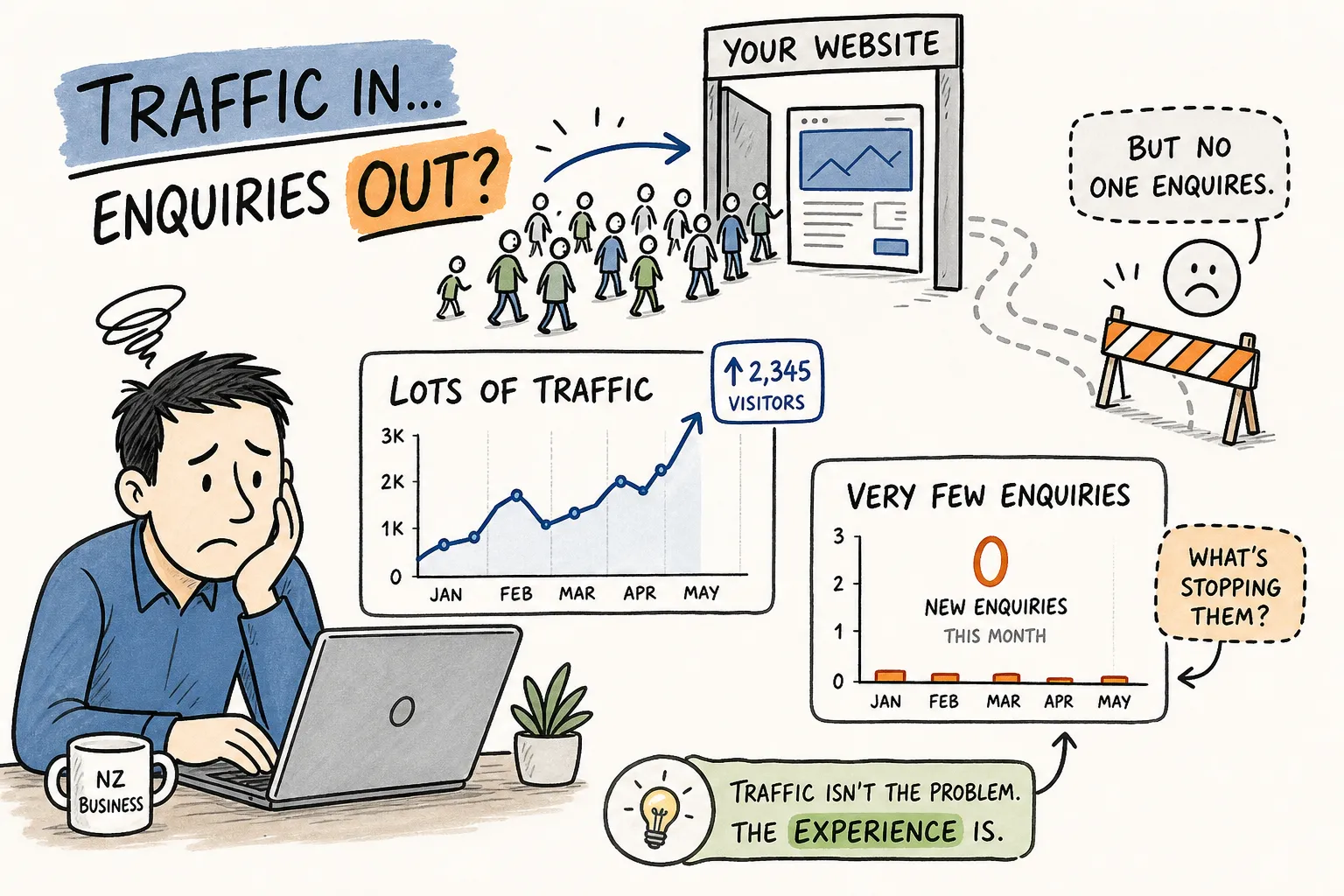
You open Google Analytics and the numbers look reasonable. Sessions are up, maybe even growing. But the inbox is quiet. No quote requests, no phone calls, no enquiries. That gap between the traffic report and the silence in your inbox is one of the most demoralising things a small business owner can experience online.
The instinct is to assume you need more traffic. More ads, more social posts, more SEO effort. After working with small businesses across New Zealand, the team at Fairweb has found that instinct is frequently wrong. The problem is rarely upstream. It sits between the visit and the enquiry, in the moment a real person lands on your site and decides whether to reach out or close the tab.
This article walks through the most common reasons NZ websites fail to convert visitors into enquiries. Think of it as a diagnostic framework you can run yourself, so you know exactly where to focus your energy before spending another cent on traffic.
Why is my website not getting any enquiries in New Zealand?
If you're asking why your website is not getting enquiries in New Zealand, the answer is almost never "not enough traffic." Traffic volume and enquiry volume are completely separate metrics. Confusing the two is how business owners spend months optimising the wrong thing. A site can attract thousands of visitors a month and still produce zero leads if the conversion fundamentals are broken.
Before assuming something is wrong, it helps to know what reasonable looks like. For NZ small businesses, enquiry conversion rates vary by industry: trades and home services typically sit between 3% and 6%, professional services between 1.5% and 4%, and health and wellness between 2% and 5%. These are site-wide averages. Individual service pages, when well-structured, can convert at 5% or higher. If your site is sitting well below these ranges, that's a signal worth investigating. If you're not sure what your current rate is, open GA4, navigate to Reports, then Acquisition, and compare your total sessions against your tracked form submissions or goal completions.
The diagnostic mindset here is simple: fix the leak before adding more water pressure. Bringing more visitors to a website that doesn't convert doesn't scale success, it scales the problem.
Messaging issues that stop visitors from enquiring
This is where most NZ small business websites quietly bleed enquiries. The page loads, the visitor reads a line or two, feels nothing specific, and leaves. Not because the business is poor quality, but because the website didn't speak to them directly.
The most common messaging failure is the vague value proposition. Phrases like "quality solutions for all your needs" or "your trusted local provider" communicate almost nothing to someone who just found you on Google. A strong NZ-specific value proposition names the service, the location, and the outcome clearly. Compare "quality plumbing solutions for your needs" with "Auckland plumber helping homeowners fix leaks within 24 hours." The second version tells a visitor immediately whether they're in the right place. Your homepage headline is one of the most critical elements on your entire website — if it doesn't answer what you do, who it's for, and where you operate, visitors will leave before they reach your contact form.
Generic CTA text is a silent conversion killer too. "Submit," "Contact Us," and "Learn More" give the visitor no reason to act and no sense of what happens next. Benefit-driven language works better: "Get a free quote today," "Book your consultation," or "Call us now for same-day availability." The language tells visitors what to expect, which removes a layer of hesitation.
CTA placement matters just as much as the copy. Your primary call-to-action should appear above the fold, repeat after key content sections, and sit on every service page. If a visitor has to scroll to the footer to find a way to contact you, most of them won't bother.
UX and technical friction blocking conversions
A visitor who wants to enquire but can't do so easily will not try harder. They'll simply leave. New Zealand has high mobile usage rates, and the majority of local searches happen on a mobile phone, so this is not a minor issue for service-based businesses.
Page speed has a direct relationship with conversion rates. Research from Google and VWO suggests a one-second delay can reduce conversions by around 8%, and Google's current Core Web Vitals benchmarks set the "good" threshold for Largest Contentful Paint at 2.5 seconds or under. Many small business websites fall short of that on mobile. The quick wins are image compression, removing unused plugins, and switching to faster hosting. For current mobile performance targets, see Google's mobile page speed industry benchmarks.
Thumb-friendly design is equally important. Buttons should be at least 44x44 pixels to be tapped comfortably, text should be readable without zooming, and navigation should be simplified. If your site looks fine on a desktop but awkward on a phone, you're losing enquiries from a significant portion of your visitors. None of these require a full rebuild — but if you do need a redesign to fix core UX problems, a focused website design and development approach that prioritises conversions will usually deliver faster results than a cosmetic overhaul.
Contact forms fail in predictable ways: too many fields, no success confirmation message, or notifications that land in spam rather than your inbox. Test your own form right now by submitting a test enquiry and timing how long it takes to arrive. If you don't receive it within a few minutes, or at all, visitors are falling into that same black hole. If your site runs on WordPress, this checklist on how to properly test your forms before launching is a useful reference. Phone numbers must be tappable on mobile, not just displayed as static text — a clickable tel link turns a phone number into a one-tap action for someone standing in their driveway looking for a tradie. These interactions should also be tracked in GA4 so you know how many people are clicking to call, and where they're dropping off before they reach out.
Missing trust signals that make visitors hesitate
In New Zealand, personal reputation has always carried weight. Word of mouth is how most local businesses grow. Online, that reputation needs to be visible before someone who doesn't know you will press send on an enquiry form. Most small business websites underestimate how much trust signals matter at the exact moment a visitor is deciding whether to reach out. There's more on why trust signals are often the missing link on local business websites if you want to dig deeper.
A local phone number displayed prominently, not buried in the footer, signals that a real person is reachable. Testimonials that name specific NZ towns or suburbs carry more weight than generic five-star quotes because they feel verifiable. For trades and home services, accreditations, trade memberships, and certifications matter enormously. A Master Plumbers logo or a Licensed Building Practitioner badge answers a trust question before the visitor even thinks to ask it.
Real photos of your team, your work, or your premises generally outperform stock imagery. Visitors are deciding whether to invite you into their home or hand over their business. A genuine photo of a completed job in Tauranga or a team shot taken in your Hamilton workshop signals authenticity in a way that a generic handshake graphic never can.
Placement is the other half of the equation. Trust signals placed near your CTAs reduce hesitation at the exact moment it's highest. A cluster of Google reviews adjacent to a "Get a free quote" button works harder than the same reviews sitting on a separate testimonials page. Star ratings, review counts, and recognisable certification logos should appear on service pages, not just the homepage. The goal is to answer trust questions at the same moment you're asking the visitor to act.
Wrong traffic and local SEO gaps
Sometimes the website itself is not the core problem. The visitors arriving are simply the wrong people, browsing for information, located outside your service area, or looking for something you don't offer. Understanding traffic quality is just as important as traffic volume — web traffic analytics can help you identify which channels are sending low-quality visits.
Someone searching "how to unclog a drain" is probably not going to hire a plumber. Someone searching "plumber Wellington same day" almost certainly is. Informational traffic inflates your session count without contributing to your enquiry count. Google Search Console makes this visible: open the Performance report, filter by page, and look at the queries bringing visitors to your site. If the queries are mostly how-to or general information searches, you're attracting browsers, not buyers. In GA4, check your Traffic Acquisition report and compare conversion rates by channel — channels with high sessions but low or zero conversions are where mismatched traffic is concentrated, and high bounce rates on those same channels confirm it.
Targeting broad national keywords when your business only serves one region is a common and costly mistake. "Plumber NZ" and "plumber Tauranga" are completely different searches with completely different buyer intent. The second one is the one that converts. Service pages built around specific locations, rather than generic service descriptions, align with how local customers actually search and give Google clearer signals about who the page is for. For a practical walkthrough, see our guide to SEO and local SEO for NZ small businesses.
Google Business Profile completeness plays a significant role here too. Missing categories, no photos, incomplete service descriptions, or stale contact details all reduce visibility in local search and lower the quality of enquiries that do arrive. Keeping your business name, address, and phone number consistent across your website, GBP, and any directory listings is the foundation of local SEO. Without it, you're sending conflicting signals to both Google and potential customers. Our guide to local SEO for NZ small businesses walks through this in more detail.
How to audit your website and start fixing it
The following four-point audit takes less than an hour and surfaces the issues that matter most. Run through it before spending anything more on traffic.
- Read your homepage out loud. Does it clearly state what you do, who it's for, and where you operate? If you find yourself pausing or rephrasing, a visitor will feel the same confusion.
- Test your site on mobile as a new visitor would. Open your website on your phone, find the contact form, tap the phone number, and note every moment of friction you experience along the way.
- Submit your contact form with a test enquiry and time the notification. Check your inbox, spam folder, and junk mail. If it doesn't arrive within a few minutes, you're losing enquiries silently.
- Pull your GA4 Traffic Acquisition report and compare conversion rates by channel. Look for channels with high sessions and low conversions — those are the ones worth investigating first.
If the audit reveals unclear messaging throughout the site, issues across multiple pages, or technical performance problems you're not sure how to address, a conversion-focused review of the full visitor journey — from first click to enquiry — will get you further than a generic SEO audit that only examines rankings and backlinks. For another practical take on why websites can get traffic but no enquiries, this write-up is worth a look.
That's exactly the kind of work Fairweb does for NZ small businesses. If you'd like a clear picture of where your site is leaking enquiries and what to fix first, get in touch for a no-obligation review — just a straight, plain-language assessment of what's working, what isn't, and where your next enquiry is getting lost.
Frequently Asked Questions
Why is my NZ website getting traffic but no enquiries?
Traffic and enquiries are separate metrics — a site can have many visitors but still produce few or no leads if conversion fundamentals are broken. Common causes are weak messaging, unclear calls-to-action, poor CTA placement, or pages that don't tell visitors what you do, who you serve, and where you operate. The diagnostic rule from Fairweb is: fix the leak before adding more water pressure — address on-site conversion issues before buying more traffic.
How do I calculate my enquiry conversion rate in GA4?
Open GA4, go to Reports then Acquisition and compare your total sessions against your tracked form submissions or goal completions. Divide enquiries (form submissions or calls tracked as conversions) by total sessions to get a site-wide conversion rate, then compare it to industry benchmarks.
What are reasonable conversion rates for NZ small businesses?
Typical site-wide averages in New Zealand vary by industry: trades and home services usually sit between 3% and 6%, professional services between 1.5% and 4%, and health and wellness between 2% and 5%. Individual, well-structured service pages can convert at 5% or higher, so underperforming sites below these ranges are worth investigating.
How should my homepage headline be written to stop visitors leaving?
Your homepage headline must answer what you do, who it's for, and where you operate — clearly and quickly. Replace vague phrases like "quality solutions for all your needs" with a specific value proposition such as "Auckland plumber helping homeowners fix leaks within 24 hours" so visitors immediately know they're in the right place.
Why are my calls-to-action not generating clicks?
Generic CTAs like "Submit," "Contact Us," and "Learn More" provide no incentive or clarity about the next step, which increases hesitation. Use benefit-driven language — for example "Get a free quote today," "Book your consultation," or "Call us now for same-day availability" — and make the outcome of clicking explicit to improve conversions.
Where should I place primary calls-to-action on my site?
Your primary CTA should appear above the fold, repeat after key content sections, and be present on every service page. Proper placement ensures visitors see a clear next step without hunting for the contact form, reducing friction and improving the chance they'll enquire.
Should I invest in more SEO and ads if my site isn't getting enquiries?
Not immediately — bringing more visitors to a site that doesn't convert only scales the problem. First run a conversion diagnostic (messaging, CTAs, placement, tracking) and fix on-site issues; once conversion fundamentals are working, additional traffic will produce meaningful enquiries.
Related Service
Website Redesign & Optimisation
See how Fairweb supports New Zealand small businesses with website redesign & optimisation.
Learn more