_1779606969667-ZJZA6fNi.png)
_1777949319555-DTVd6WJp.png)
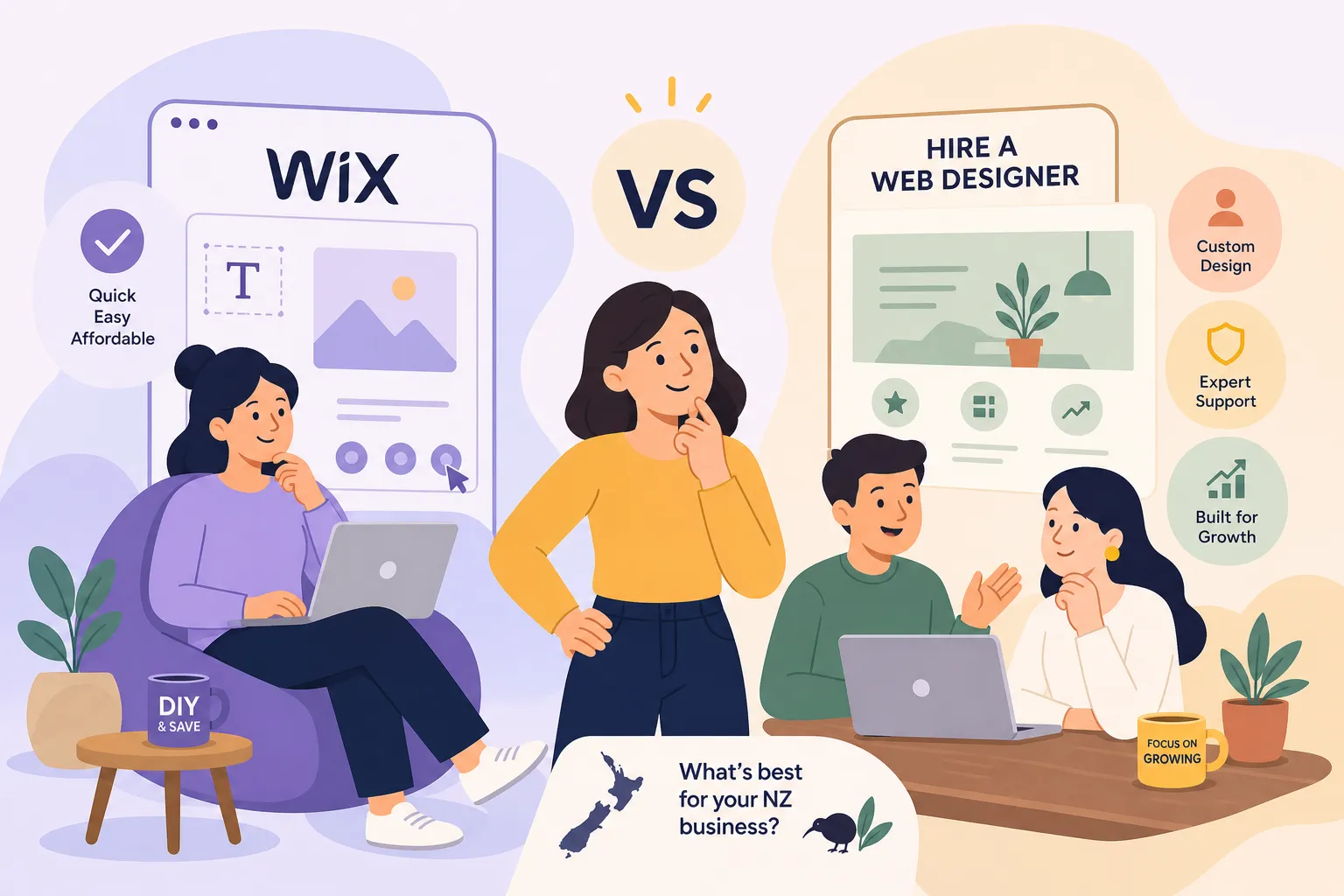
Wix looks like the obvious answer. It's cheap, it's fast, and the ads make it look effortless — so most small business owners sign up, spend a weekend on it, and end up with something that technically exists on the internet but doesn't do much else. If you're weighing up whether to use Wix or hire a web designer for your NZ business, you're probably already sensing that the easy option isn't quite delivering.
Plenty of New Zealand small businesses try the DIY route first, then circle back wondering what went wrong. The honest answer isn't "Wix is bad." Whether to use Wix or hire a web designer comes down to factors most comparison guides skip: what the website actually needs to do, how much of your own time you're willing to spend managing it, and whether the long-term cost calculation genuinely favours the cheaper option.
This guide breaks that down without the filler — the real operating models behind each option, what they cost NZ businesses over three to five years, and how to tell which one is right for where your business is at.
What you're actually deciding here
DIY builders and professional web design aren't just different price points — they're different operating models. With Wix, you take on everything: the layout, the written content, the SEO settings, the ongoing updates, the troubleshooting. With a designer, you hand that responsibility to someone whose job is to get it right. Neither model is universally better. The real question is whether you have more time or more money, and which one you're more willing to spend.
A Wix site gives you a hosted, template-based website built with drag-and-drop tools or their AI builder. Standard plans include editable templates, mobile responsiveness, basic SEO controls, and an app market for extras like booking forms or live chat. It's a genuinely capable platform for what it is. The limitations show up when you need advanced URL control, custom schema, or high-performance e-commerce — usually sooner than most people expect.
A professionally built site starts from a different place. The design is structured around the specific business, the content is written or directed by someone who understands conversion, and SEO foundations are built in from day one. Some NZ agencies bundle hosting, maintenance, and SEO into a single managed service, which means no juggling multiple vendors and no learning curve on platform settings you'll only touch twice a year.
What each option actually costs NZ businesses
Wix's Light plan runs around NZD $265–$275 in Year 1, which includes a free domain. From Year 2, domain renewal adds roughly NZD $10–$18 a year. Add one or two paid apps — a booking tool, an analytics upgrade, a live chat widget — and the annual cost climbs to NZD $350–$500. Factor in a business email address and you're looking at NZD $500+ per year.
It's worth noting that Wix prices are displayed in USD, so NZ customers pay in converted NZD with GST included. Some users report renewal rates increasing noticeably after the first year, so it pays to check the renewal terms before you sign up rather than after. For up-to-date plan details, check Wix's own pricing, and if you're after local options, some organisations list discounted Wix subscriptions for New Zealand small businesses.
A professionally built brochure site from a NZ freelancer or small agency typically runs NZD $1,000–$3,000 for a standard five-page small business site. A basic e-commerce build sits closer to NZD $3,000–$5,000. That's a larger upfront number, and there's no point pretending otherwise. But the ongoing cost picture changes when you account for three to five years of platform fees, the time you spend managing the site yourself, and the value of the enquiries a well-built site generates versus one that doesn't convert. Our guide to how much a website costs in NZ breaks down typical budgets and what to expect, and this local breakdown of website development costs offers another NZ perspective.
Customisation and brand control: where templates hit their limits
Wix templates are polished, and most small businesses can produce something that looks professional at a glance. The ceiling shows up when you need the layout to behave in a specific way, when you want your brand to feel genuinely distinct from competitors, or when you want page structure built around how your customers actually make decisions. Wix gives you control over the cosmetics. It doesn't give you control over the deeper architecture of a page designed to convert.
A designer-built site starts from the customer's perspective: who they are, what they need to see before they trust a business, and what action they need to take. The placement of a contact form, the flow of a homepage, the way a services page is written — these are deliberate decisions that directly influence enquiry rates. This is the part that's genuinely hard to replicate with a template, no matter how long you spend tweaking the colours and fonts. If a distinctive, conversion-focused build is what you're after, that's the core of what website design and development involves.
SEO: where the real difference shows up
Wix has improved significantly over the past few years, and it's worth being fair about what it does well. Editable meta titles and descriptions, automatic sitemap generation, mobile optimisation, and schema support are all included. For a local NZ service business targeting straightforward suburb or city-level searches, Wix is capable enough to compete. Terms like "plumber Tauranga" or "bookkeeper Hamilton" are achievable on a well-maintained Wix site with properly written content and a claimed Google Business Profile.
The limitation shows up when SEO becomes more strategic. Advanced control over URL structures, canonical tags, redirects, site speed, structured data, and plugin ecosystems is considerably stronger on a custom or WordPress-based build. For NZ businesses targeting competitive national keywords, building content clusters, or wanting full technical SEO flexibility, a professionally built site provides room to grow that Wix can't match. A useful shorthand: Wix lowers the barrier to competent SEO, but a custom build raises the ceiling. For a detailed look at how Wix stacks up, this practical analysis of Wix SEO features is worth a read.
The other factor that doesn't appear in platform comparisons is the human one. Many Wix sites underperform not because of the platform itself, but because they were built quickly without SEO planning — no proper page titles, no metadata, no content written around real local search intent. The platform can support good SEO; most DIY builds simply don't use it properly. Our approach to SEO and local SEO for NZ small businesses is built around exactly that gap.
Time investment: who actually saves more time?
Wix's own materials suggest a basic site can go live in a few hours. That's accurate for a minimal setup. A functional, professional-looking small business site — with the right pages, properly written content, contact forms, images, and SEO settings configured — typically takes several hours up to a full day for someone doing it for the first time, depending on scope. Then there's the ongoing time: updating content, troubleshooting layout issues on mobile, learning new features, and managing SEO settings manually.
In practice, estimates range from around one to three hours a month for light maintenance to four to eight hours or more for more active sites. That time cost never appears in the subscription fee.
When you hire a professional, your role in the process is to provide information and sign off on decisions. The build, the SEO setup, the hosting, the ongoing updates — those belong to the designer. For busy NZ small business owners, this is often where the real value sits. If you're comparing agencies and freelancers, our guide on how to choose a web design company in NZ is a useful starting point; some agencies handle everything under one roof, so your time goes back into running the business rather than into a website editor you only half understand.
Should I use Wix or hire a web designer? Here's how to decide
A DIY approach makes sense in specific circumstances. If the business is pre-revenue or in early testing mode, if the site is genuinely simple (one service, one location, no complex booking logic), and if the owner has some comfort with technology and time to invest, Wix is a reasonable starting point. For validating a business idea before committing to a full build, it does the job.
The signs that point toward hiring a professional are more specific:
- The website is a primary source of enquiries — or it should be.
- The business operates in a market where Google rankings actually matter.
- The current site isn't converting visitors into leads.
- You've already tried DIY and found it consuming more time than it's worth.
- You're competing against local operators who have properly built sites.
The choice is really about what your website needs to do
At the point where those signs start stacking up, a professional build stops being an expense and starts being an investment with a measurable return. Both options work — for different businesses at different stages. Wix isn't the wrong choice for every situation, and hiring a designer isn't automatically the right one. The question that actually matters is what the website needs to do for the business, and whether you have the time and technical appetite to manage it yourself over the long run.
If the website needs to generate real enquiries, rank in NZ local searches, and represent the business credibly to customers who've never heard of you before, a professionally built site is the more reliable investment. The upfront cost is higher. The ongoing management is handled for you. And the SEO foundations are there from day one rather than retrofitted later, after the site has already underperformed for a year.
Both paths are valid — the right one depends entirely on where your business sits today and where you want it to go. If the DIY approach is delivering everything you need, there's no reason to change it.
But if you're at the point where Wix isn't quite cutting it, Fairweb offers a no-pressure conversation about what a proper build would look like for your business. Just a straight, plain-language chat about what's involved and what it costs — get in touch whenever you're ready.
Frequently Asked Questions
Should I use Wix or hire a web designer for my NZ business?
It depends on where the business is at. Wix is a reasonable choice for early-stage or simple sites where budget is tight and the stakes are low. If the site needs to rank in Google, convert visitors into enquiries, and represent an established business, a professionally built site is likely the better long-term investment — particularly once you factor in the ongoing time required to manage a DIY build.
How much does it cost to build a website in New Zealand?
A Wix subscription typically runs NZD $265–$500+ per year depending on the plan and apps you need. A professionally built small business site from a NZ designer or agency generally starts from NZD $1,000–$3,000 for a brochure site, or NZD $3,000–$5,000 for a basic e-commerce build. Ongoing hosting and maintenance costs vary by provider.
Is Wix good enough for SEO in New Zealand?
For local searches targeting specific suburbs or cities — "electrician Wellington" or "accountant Dunedin" — a well-maintained Wix site with good content can compete. For more competitive or national keywords, or when you need technical SEO flexibility, a custom or WordPress-based site offers significantly more headroom.
What's the real difference between Wix and hiring a web designer?
The biggest differences are control and time. Wix hands you the tools and expects you to use them. A professional designer handles the build, the strategy, and the ongoing maintenance, so your time stays focused on the business. The upfront cost is higher, but the ongoing management burden is substantially lower.
Related Service
Website Design & Development
See how Fairweb supports New Zealand small businesses with website design & development.
Learn more